Most people come to Hà Giang for the road. They leave talking about a person.
It might be the grandmother who refilled your tea four times without being asked, or the boy who ran alongside your bike for thirty metres just to wave. Ask travellers a year later what they remember, and it is rarely the viewpoint. It is a face.
Hà Giang is the most ethnically diverse province in Vietnam — home to more than nineteen groups, each with its own language, dress, architecture and calendar. Understanding even a little of who lives where changes the whole ride. The landscape stops being scenery and starts being somebody’s home.
Who lives up here
The Hmong are the largest group, roughly a third of the province. They live highest, farming maize on slopes so steep it seems impossible, and they are the people you will most often see at the markets in indigo and embroidered cloth.
The Tày live lower, in the valleys, in wooden stilt houses beside the rice terraces. If you stay in a homestay with a wide wooden veranda and a fire pit downstairs, you are probably a guest of a Tày family.
The Dao are known for herbal medicine and for the red headscarves of the Red Dao women. Ask about the herbal bath — many families still prepare one, and after six hours on a bike it is a revelation.
Then there are the small groups: the Lô Lô, whose village of Lô Lô Chải sits just below the flag tower at Lũng Cú, and the Pu Péo and Cờ Lao, among the smallest ethnic populations in the whole country — a few thousand people, holding onto their language.
The four people you will probably meet
Your homestay host. She will feed you more than you can eat and be quietly offended if you finish early. Dinner is the real experience here — not a menu, just whatever the house is eating.
The woman at the market. She may have walked two or three hours before sunrise carrying what she is selling. If you buy something, buy from her rather than the stall by the car park.
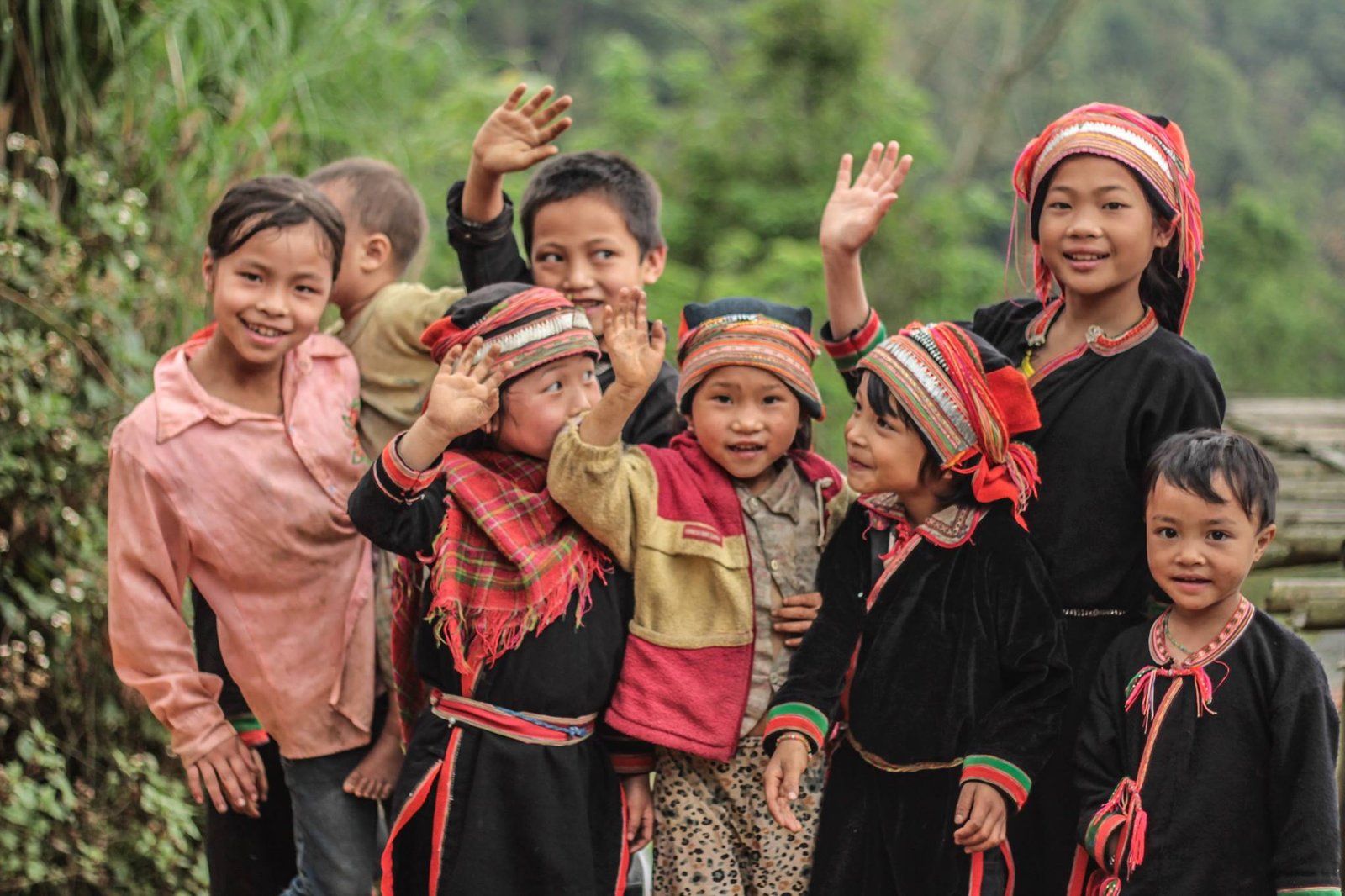
The children. They are curious and completely unbothered by you. A wave is enough. Sweets and money teach a village to see visitors as a source of things, which is not a kindness — a photograph shown back to them on your screen usually gets a better laugh anyway.
An elder. This is the encounter that tends to stay with people. Many older men and women here remember when there was no road at all, when everything came in on foot over the mountains. They have watched their world change more in one lifetime than most of us will in three.
How to meet people well
A few things make a genuine difference, and none of them are complicated.
Ask before you photograph. Hold up the camera, catch their eye, wait for the nod. Some people will say no. That is a complete answer.
Learn two words. Xin chào* and cảm ơn* will do — hello and thank you. The effort registers far more than the accuracy.
Accept the tea. Be careful with the corn wine. Hospitality is offered generously and refusing outright can sting. Accepting one glass and then slowing down is understood perfectly well.
Let the ride be slow. The best conversations happen because you stopped for forty minutes instead of ten. Nothing on this loop rewards hurrying.
Why we do it this way
We are a local team. Some of our guides grew up in the villages you will ride through, and the homestays we use belong to families we actually know — which is the only reason those dinners feel like being a guest rather than a customer.
That is also why we keep groups small. Fifteen motorbikes arriving at once turns a household into a business. Four or five is a visit.
Come for the road. It genuinely is one of the great rides in Asia. But leave room in the trip for the people, because that is the part you will still be describing to friends next year.